The Scoreboard Before the Digital Screen
The scoreboard before the digital screen made spectators read a contest through changing cards, panels and lamps; learn what each format revealed.
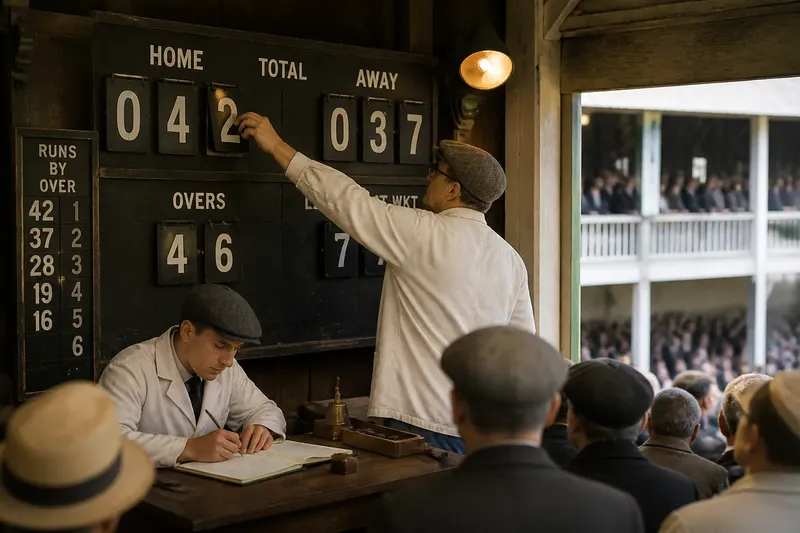
The scoreboard before the digital screen asked spectators to read the contest from a set of physical clues: a card turned by hand, a number slid into a frame, a lamp switched on. Those displays did more than record a score. Their layout decided which parts of a game the crowd could see, and how quickly it could see them.
Following that change is easiest if you watch a match in stages: first, notice what a manual board makes visible; then consider how its operator updates it; finally, compare what an electronic display adds and what it can obscure. The point is not that one format is more authentic. Each gives the audience a different view of the contest.
Begin with the visible score
A manually updated board usually made the score a physical arrangement. A person might flip numbered cards, move a marker along a track or replace a panel. The crowd saw not just a new figure but the action that produced it: an arm reaching up, a card turning, a number settling into place.
That visible action made the update part of the event’s rhythm. A spectator could notice the operator’s movement and understand that the board was changing, even from a distance. If a player’s score was recorded on a chart or panel beside the main total, the display could also show how the result had accumulated rather than presenting only its latest state.
But physical displays had a limited vocabulary. The board could show only what its available cards, slots or markers allowed. A small panel might fit the score and little else; a more elaborate one could add innings, periods or player names, but every extra detail needed space and a way to change it.
Follow the operator
At a manual board, the operator was part of the information system, though rarely the star of it. Someone had to watch the officials, interpret the event and make the correct alteration. The board’s accuracy and pace depended on that chain of attention.
There was a useful, if limited, transparency in seeing a person perform the update. If the number changed immediately after a point, the audience could connect action and record. If it did not, the delay was also visible. The board could not quietly revise itself; a person had to touch the display.
Imagine a community match where the main board uses flip cards and the scorer’s table keeps a written sheet. A point is awarded, but the card-turner looks down at the sheet before changing the board; spectators see the pause and wait for the figure to settle. The separate record gives the operator something to consult, while the board remains the audience’s public version of events.
This arrangement also explains why manual boards were not simply crude versions of electronic ones. Their operators made choices about what to show and when to update it. In a game with several layers of scoring, a compact board might favour the running total, leaving finer detail to a programme, a score sheet or an announcement.
Watch the display change
As games and venues adopted electronic boards, the update became less visibly mechanical. A score could change through a button press or a linked control system, while lamps and illuminated figures made the result legible across a larger space. The audience saw the new state without necessarily seeing the person or process behind it.
Electronic displays widened the board’s vocabulary. A screen could show the score alongside a clock, period, player number or short message, then replace that information as the contest moved on. In some sports, separate fields could distinguish team totals from individual details; in others, the board could give prominence to a countdown or a round number.
That flexibility altered spectators’ attention. A manual board tended to preserve a stable arrangement: the same panels stayed in place while figures changed. An electronic screen could shift its layout, enlarge one detail and then substitute another. The audience gained information, but also had to learn where the relevant detail had moved.
The electronic board also made updates appear more immediate. That can help a crowd follow a quick sequence, but immediacy is not the same as explanation. A changed total may tell spectators what the current score is without showing how a disputed decision, penalty or correction led there. The display presents a state; it does not always present the reasoning behind it.
Compare what each shows
To understand a scoreboard, look at its hierarchy rather than its technology. Ask which number attracts the eye first, which details stay visible, and which disappear when the display changes. Those choices reveal what the venue assumes spectators most need to know.
- Running score: A large total makes the broad contest easy to follow, but may leave out how the score is divided.
- Time or period: A clock or period label helps place the score in the match, especially when a total alone says little about the remaining play.
- Player or team detail: Individual figures can explain who is contributing, provided the display leaves them visible long enough to read.
- Change of state: A new card or illuminated number makes the update apparent; a screen transition can also draw attention, though its meaning depends on the information shown.
A board is therefore a small editorial object. It selects, orders and withholds. A venue with a manual display may make the score’s physical alteration unusually clear; a digital one may place more parts of the contest within reach. Neither format automatically gives the crowd a fuller understanding.
What should spectators notice?
Why did manual boards need an operator?
Someone had to translate the officials’ decisions and the scorekeeper’s record into a visible change. That person also determined the pace at which the board caught up with play.
Did electronic boards replace every manual display?
No single change made every older format disappear. A venue may retain a simple physical board for a local match, use an electronic display for a larger event, or combine a main screen with a separate score sheet.
Why can a screen show more than a card board?
A screen can reuse the same area for different kinds of information, while a physical board is limited by its fixed panels and available markers. That extra capacity is useful only if the audience can still find the score and understand the labels.
Can a scoreboard explain a disputed decision?
Usually, it shows the outcome recorded for the contest, not the full reasoning behind an official’s call. An announcement or explanation from the officials may be needed when the change is not self-explanatory.
Read the board in sequence
When watching a game, make a simple pass through the display. First find the main score, then check the clock or period, and finally see whether the board offers player figures or another detail that changes the meaning of the total. If a number changes, notice whether the layout explains the change or merely reports its result.
This habit works with old and new boards because it focuses on the information rather than the hardware. A card turning by hand and a screen refreshing electronically both answer the same basic question—what is the contest’s recorded state? They differ in how much context they make visible, and in how openly they show the act of updating it.
The scoreboard before the digital screen is easiest to appreciate when treated as a public performance of record-keeping, not as a failed attempt at a modern screen. Its cards and markers made the update visible; electronic boards made the display more flexible. Next time a score changes, look for the operator, the layout and the detail that remains on view. That is often enough to tell what the venue thinks the crowd should follow.