Man-to-Man or Zone: Two Different Ways to Defend Space
Man-to-man or zone defence becomes easier to read when you track who follows a player, who protects a patch of court and how defenders respond to movement.
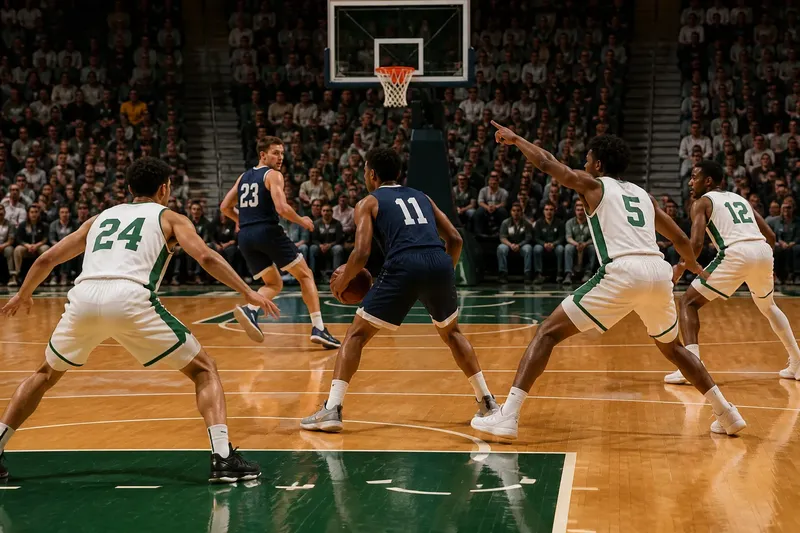
Man-to-man or zone defence is easiest to recognise by watching what a defender does when an attacker moves away from the ball. If the defender follows, the assignment is probably player-focused; if the defender holds a patch of court and passes the runner on, the team is probably defending an area. That small distinction explains much of the shape you see in basketball, netball, football and other invasion games.
Follow the assignment
In man-to-man defence, each defender takes responsibility for an opponent. The assignment need not mean standing nose-to-nose throughout the possession: defenders can shade a dribbler towards help, deny a pass, or switch opponents after a screen. The defining feature is that a particular attacker remains the defender’s primary concern.
Watch a basketball possession before the shot. If a forward cuts from the wing through the lane and a defender travels with them, that is a useful clue. If the defender instead stays near the lane and another teammate picks up the cutter, the team may be using zone principles, or a hybrid arrangement.
Player-focused defence makes individual duels visible. A defender must keep an opponent in view while also checking the ball, nearby screens and possible passing lanes. Turning entirely to follow a player can lose sight of the ball; watching only the ball can lose the assignment. Neither lapse is especially subtle to the attacker.
Protect the patch
In zone defence, players are responsible chiefly for areas rather than fixed opponents. A defender challenges an attacker who enters their patch, then may hand that attacker over as they move into a teammate’s area. The precise boundaries are usually elastic: defenders shift together as the ball moves, rather than guarding invisible squares painted on the floor.
In basketball, a compact zone often crowds the space near the basket and asks the offence to make passes around its edge. In football, a team defending zonally may protect central lanes and pass runners between players, though pressing systems can combine area coverage with direct pressure on whoever receives the ball. The same label does not describe one identical formation across every sport.
To read a zone, follow a player who crosses several defenders’ positions. If each defender tracks the ball and the next threat in their area, while the runner is passed along, area responsibility is likely doing the organising. A player moving freely does not by itself prove a zone: the defence may simply be switching assignments or recovering after a screen.
Read the handover
The moment a runner crosses a defensive line often reveals more than the formation before the ball moves. In man-to-man, the original defender commonly follows, unless a screen or tactical switch changes the assignment. In a zone, a teammate may call, point or shift across to take the runner while the first defender returns to the ball or another threat.
Imagine a basketball team begins with a defender attached to each opponent. An attacker sets a screen, and the two defenders exchange assignments rather than forcing the original defender through it; the visible result is a new pairing, not necessarily a zone. Now imagine the same attacker cuts through the lane and two defenders briefly guard the area together before one releases the cutter to a teammate. That coordinated handover is stronger evidence of area defence.
Communication matters in both systems. A short call can announce a screen, identify a cutter or clarify who has the ball. Silence can leave two defenders chasing one attacker while another waits unmarked, an arrangement that is generous to the opposition.
Compare the trade-offs
Man-to-man can apply pressure to particular opponents and make it harder for them to receive comfortably. It can also expose a mismatch: a quick attacker may beat a slower defender, or a strong player may draw help and open space elsewhere. The team’s response depends on its ability to contain the matchup and support the defender without abandoning another threat.
Zone defence can put several defenders near a dangerous area, protect teammates from certain one-on-one contests and reduce the need to chase every off-ball movement. Its weak points often appear in the spaces between defenders, during quick ball movement, or when an attacker finds an unoccupied patch. A zone that shifts slowly can invite a pass to the far side before the defence has reset.
Neither system removes the need to defend the ball. A zone can still pressure a receiver, and man-to-man can still collapse towards the lane. Likewise, neither one automatically controls rebounds: defenders in either system must locate opponents, make contact where the rules allow, and pursue the ball. The arrangement changes the starting responsibility, not the work that follows.
What should you watch?
Does the defender follow the cutter?
Track one attacker as they move away from the ball. A defender who stays with them suggests man-to-man, while a defender who holds position and passes them on suggests zone; screens and switches can complicate the cue.
Who moves when the ball moves?
In a zone, several defenders often shift together towards the ball while keeping nearby areas covered. In man-to-man, each defender tends to adjust in relation to both their assigned opponent and the ball, so the movement may look less like one connected slide.
What happens after a screen?
Listen and look for a switch: two defenders exchange opponents, which can happen within man-to-man. If defenders instead continue protecting areas and transfer a cutter across a boundary, that is more consistent with zone responsibilities.
Can one possession use both?
Yes. Teams can change their approach during a game, and some use hybrid rules that assign one defender to a particular opponent while others protect areas. Treat the labels as descriptions of responsibility, not as a promise that every player will behave identically on every possession.
Use the sport’s clues
Rules and court layout affect what each defence can do. Basketball’s three-point line gives a zone a reason to contest perimeter shots while protecting the interior, though leaving a shooter open carries an obvious risk. Netball’s player restrictions and defined positions make defensive responsibilities more position-specific, so a viewer should not assume that a basketball-style handover has the same meaning there.
Football offers a different set of clues. A back line may hold its shape and pass an opponent from one defender to another, while a pressing player closes down the ball carrier directly. Teams can combine a zonal block behind the press with close marking near the ball; the best description may be “mostly zonal” rather than a neat single label.
Names also vary. A coach may call a formation a particular zone, but the useful spectator question remains practical: who is expected to take the next runner, and who must protect the space the runner has left? That question works even when the tactical vocabulary becomes more elaborate than the play deserves.
Keep a simple viewing note
Choose one attacker and follow them for a few possessions. Note whether the same defender stays attached, whether teammates exchange opponents after screens, and whether defenders move as a group towards the ball. A single moment can mislead; a repeated pattern is more informative.
Then watch the space rather than the player. In man-to-man, an attacker’s movement can pull a defender away and open a lane. In zone, the ball may travel around the defence until a gap appears between areas. These are tendencies, not laws: a well-organised man-to-man defence can help across the lane, and a zone can press aggressively outside it.
Man-to-man or zone defence becomes legible when you separate the defender’s opponent from the space that needs protection. Follow a runner, observe the handover, then check how the rest of the unit shifts. You will not need to guess from the formation alone, and you can leave the question of which defence is “better” to the people paid to argue about it.